

Grosman Investigations
OSINT - everything is strictly confidential and within the law.
Investigations
©
/
En
Private Detective for Personal Affairs Confidential Personal Investigations
We work where silence and results are important. Our task is to return control to you: collect facts, build a manageable plan, ensure safety and privacy. Each case is managed by a personal curator, reporting is based on agreed points
Search for people, private investigations, evidence collection, facts suitable for court. Legal methods, Russian Federation and 75+ countries
WORLDWIDE (GI)
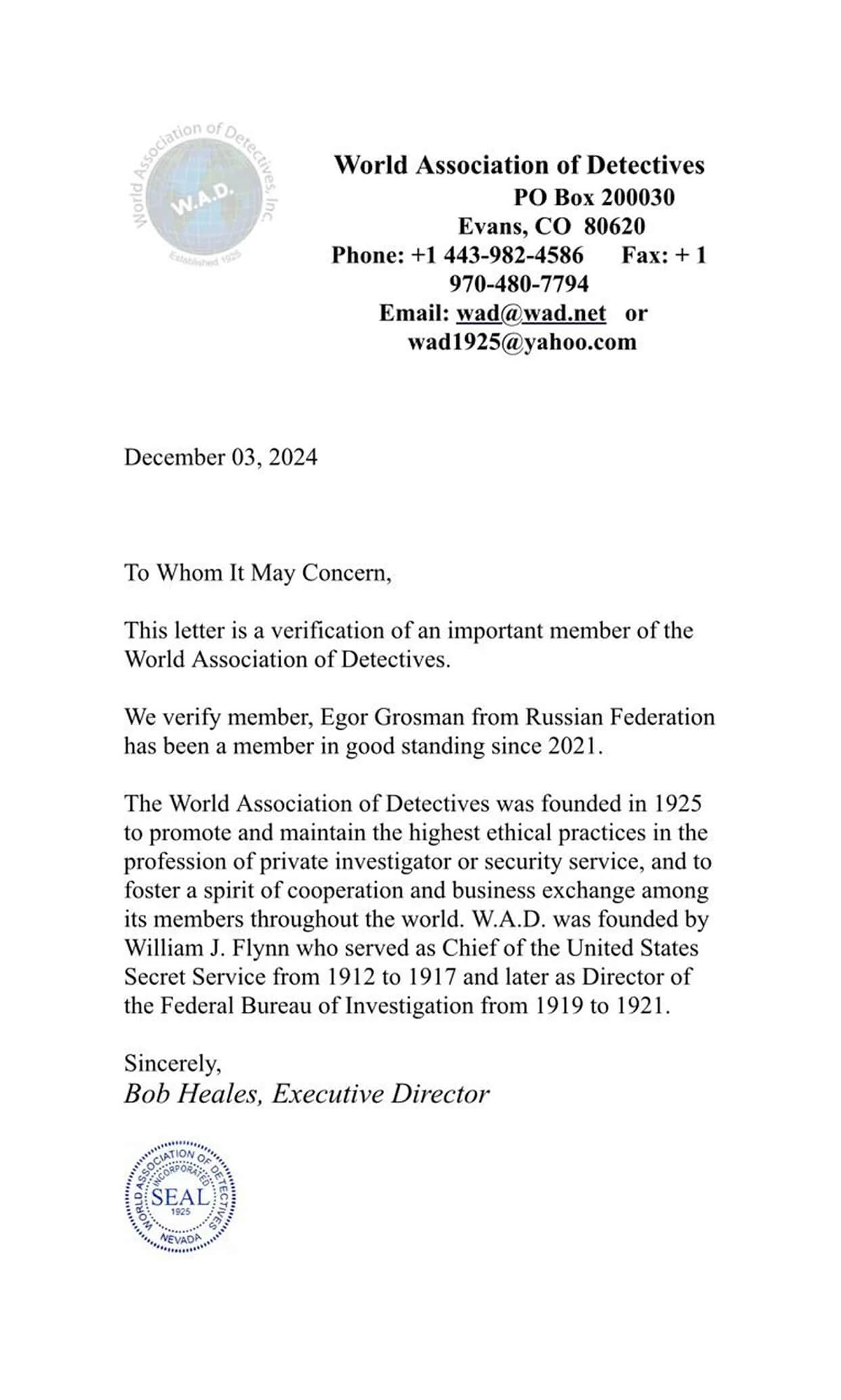
Association WAD
D 03 — 24

Get an action plan


Menu +
International detective agency
For private clients
Asset tracing
Verification of counterparties
Search for people
Corporate investigations
Services
Specific solutions for your situation
From delicate family matters to international searches.
Control, evidence base, safety
You receive evidence in a form convenient for lawyers; a clear plan of action; recommendations for minimizing risks. We work only within the law, without pressure on the client and without leaks.
Order a check
Verify a person/object with OSINT and behavioral analysis for a precise solution.
Information collection
Risk screening
Check the facts
Tactfully verify the facts and circumstances to put control back in your hands.
Family matters
Expertise
9 years +
Personalized measures against threats, blackmail, surveillance and digital attacks.
Request protective measures
Protection and security
Personal support
Sensitive and international assignments are handled under NDA, only within the legal framework.
Closed request
Special assignments
Confidentially
Observation, recording of facts, evidence base without noise.
Disassemble the case
Private investigations
Legally
Search for people
75+ countries
WAD
Grosman Egor Yurievich
Founder of the international detective agency Grosman Investigations
Member of IPA and World Association of Detectives (WAD)
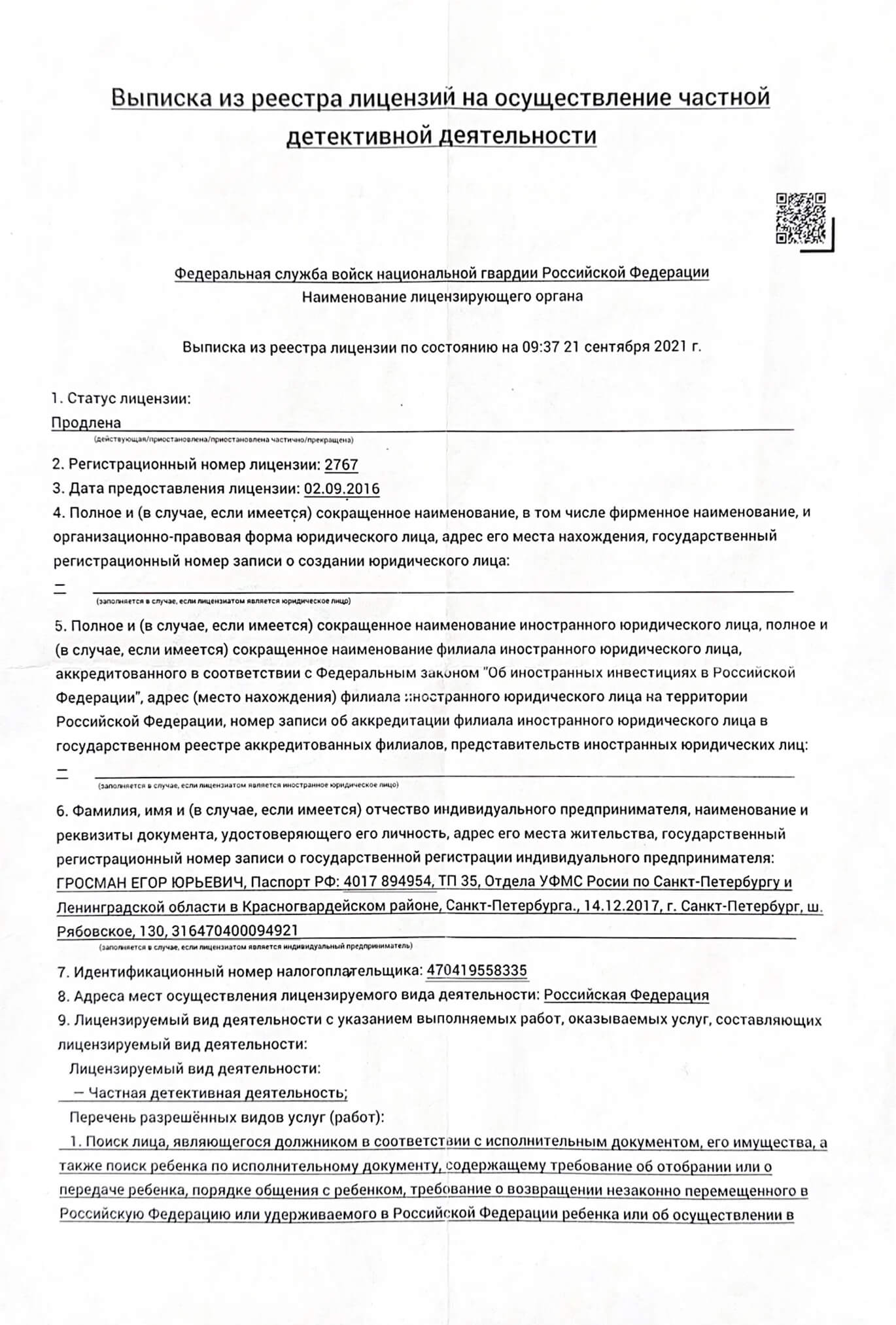
Licensed private detective. Experience in operational service in a federal structure and work in the system of protecting state secrets have shaped his approach: strict discipline, confidentiality regime and legal purity of methods.
Since 2016, he has been conducting private and corporate investigations in Russia and abroad; coordinating international cases, involving proven performers and experts in 75+ countries. The client receives not "versions", but evidence suitable for lawyers and the court: a documented chain of custody, a clear action plan and a personal approach.
Since 2016, he has been conducting private and corporate investigations in Russia and abroad; coordinating international cases, involving proven performers and experts in 75+ countries. The client receives not "versions", but evidence suitable for lawyers and the court: a documented chain of custody, a clear action plan and a personal approach.
Start a search


Your controllability and evidence base
Cases are closed on time or earlier than agreed
Leave a request and get a personal action plan
Facts that are suitable in court
Your controllability and evidence base
You don't get versions, but facts - collected legally and suitable for legal work. We record evidence and show their coherence so that the picture is transparent. Each case is assigned a curator. You understand what stage we are at, what has already been done and what will happen next. No surprises or leaks.

Leave a request
Process - discipline and deadlines
Structure of the special level. Discipline. Control. Result
A Five-Step Process That Stands the Test of Facts and Timelines
Primary study
Briefing, objectives, risks, communication channels
Hypotheses and plan
We will agree on tactics, expected artifacts and checkpoints
Execution in stages
We work quietly and consistently, recording progress
Reporting and correction
We provide confirmations and adjust the plan if necessary.
Transfer of materials
You receive a package of evidence + recommendations for further steps
Security. Legality. Privacy.
Professionalism
Confidentiality NDA
secure channels (Signal/Telegram), need-to-know access. Destruction of working copies upon request.
secure channels (Signal/Telegram), need-to-know access. Destruction of working copies upon request.
Legality Only
legally pure methods. We submit materials in a form convenient for lawyers and courts.
legally pure methods. We submit materials in a form convenient for lawyers and courts.
Security
Counterintelligence measures, cyber defense, physical security if necessary.
Counterintelligence measures, cyber defense, physical security if necessary.
Three principles that we never violate.
Grosman Investigations team with real investigative/law enforcement and analytical background. OSINT/AI tools for speed and depth.



International reach
Russia + 75 countries
WAD
WAD network, trusted partners and expertise in key jurisdictions.
WAD (≈1000 detectives), partners/agents in 75+ countries; experts admitted to practice in the jurisdictions of the USA/UK/SG/HK and others.
International coordination is carried out centrally: one curator - a single point of responsibility, a single reporting standard
We connect local resources where knowledge of the territory and rules is important. This speeds up the search and reduces the risk of errors
Investigations
©
Clarify the possibilities
Grosman Egor Yurievich
Member of the International Police Association (IPA) and the World Association of Detectives (WAD)

Each situation is unique We develop a strategy for your scenario
Decisions that we do not write about publicly are discussed in a private format.
More examples - upon personal request in Telegram / WhatsApp
Discuss the task in person
Cases. Clean result. No risks.
Real tasks. Anonymized details, without disclosing clients, nda
Reputation confirmed by the media
We appear in the media when it is necessary to explain how private intelligence and corporate investigations work in practice. Publicity is limited and careful: we do not talk about clients and do not use their stories for promotional purposes. Reputation is not built by loud headlines, but by stable results and recommendations.
Interviews, case studies and expert comments without disclosing clients
Real tasks. Anonymized details, without disclosing clients, nda


Репутация, подтверждённая СМИ
Решения, о которых мы не пишем публично, обсуждаем в приватном формате.
Больше примеров — при персональном запросе в Telegram / WhatsApp
Обсудить задачу лично

Cost of services
More than 500 entrepreneurs and companies from small businesses to corporations have trusted us with partner checks and investigations.
The cost is determined after the initial analysis and approval of the approach.
Base rate — 150$ / detective hour. We form a team configuration for the task and record control points. You see what you are paying for and manage the budget.
Our clients know: professionalism saves millions, and mistakes cost more than any tariff.
We don't sell time. We solve problems that affect safety, money and reputation. Each case requires an individual strategy, level of access and control that cannot be compared with standard services.

Cost calculation for your task
Calculate cost

Legally correct activity and applicable evidence.
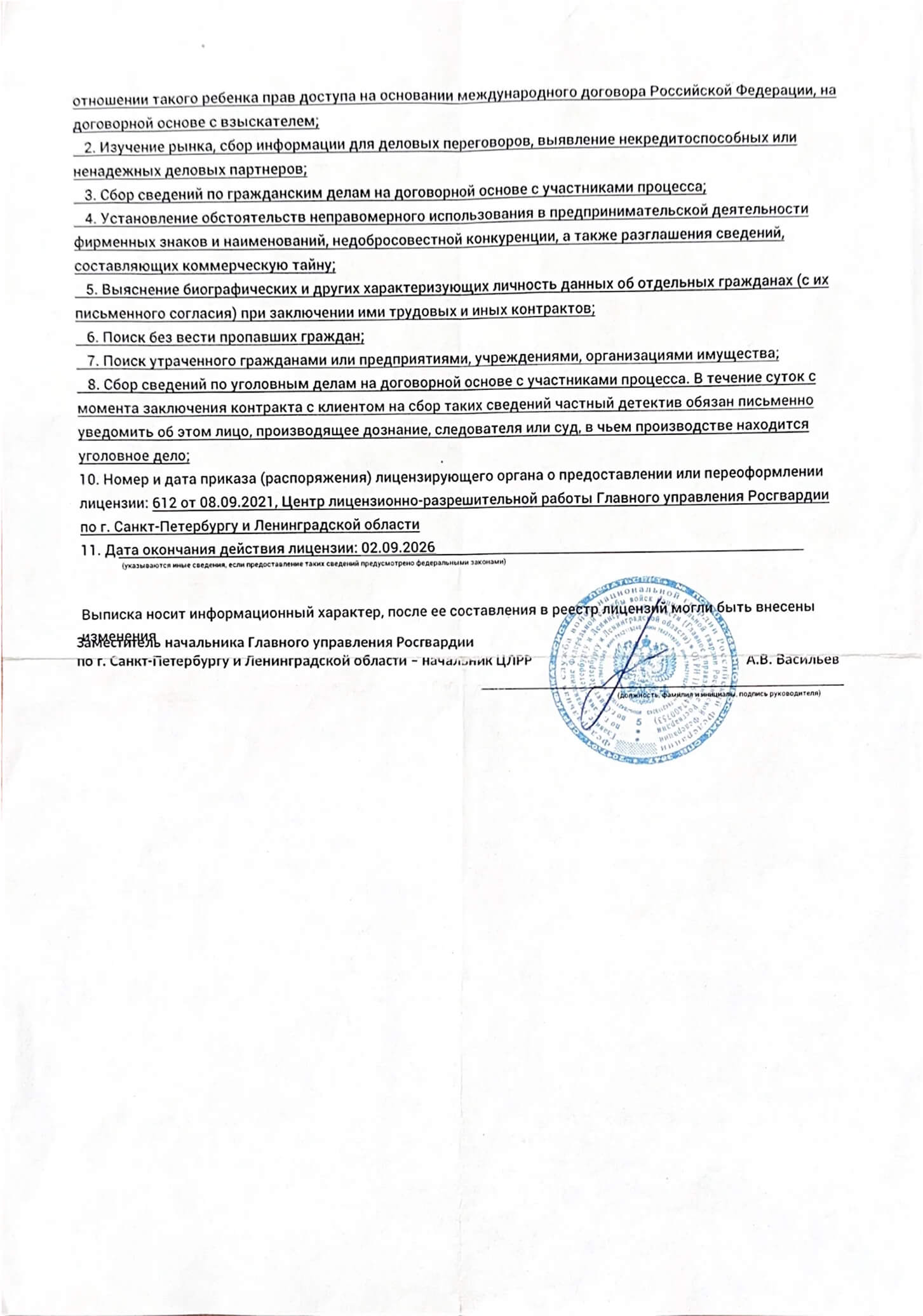
We work under license
We confirm the right to operate and follow the requirements of the jurisdictions where we operate. This protects the client and allows the collected materials to be used within the legal framework.
Frequently asked questions:
FAQ
Just what you need to know before you start
What services do you provide?
Private and corporate investigations: people search, counterparty verification, corporate security, OSINT and complex investigations.
Do you work only in Russia?
No. We work in the Russian Federation and more than 75 countries through our own network and W.A.D. partners.
What about privacy?
Absolute. NDA, secure channels, zero data leakage.
What is the price?
The cost depends on the task and risks. Minimum entry — from 150$ /hour, calculation after case analysis.
Can I do it anonymously?
Yes. Initial contact is possible without revealing identity through secure communication channels.


We will analyze your case confidentially
Contacts for personal inquiries
Links to social networks:
One contact — one curator. Minimum formalities, maximum results.
Grosman Investigations All Rights Reserved.
© 2026
Describe the situation in two or three sentences. We will return with initial hypotheses, work format and budget guidelines.
Communication - only through secure channels, without intrusive calls and "scripts". If the task requires immediate action, indicate this - we will prioritize the launch.
Communication - only through secure channels, without intrusive calls and "scripts". If the task requires immediate action, indicate this - we will prioritize the launch.
We work directly. One contact — one task. All requests are treated confidentially.
Telephone:
Messengers:
E- mail:

Investigations
©

Send request




WORLDWIDE (GI)
Association WAD
D 03 — 24
Grosman Investigations
International detective agency
Messengers:
Site sections
Fill out the form and we will return with a plan and budget guideline
We will analyze your case confidentially
Submit request


Personal Data Processing Policy
1. General Provisions
This personal data processing policy is drafted in accordance with the requirements of Federal Law No. 152-FZ of July 27, 2006 "On Personal Data" (hereinafter referred to as the Personal Data Law) and defines the procedure for processing personal data and measures to ensure the security of personal data taken by Sole Proprietor Grosman Egor Yurievich (hereinafter referred to as the Operator).
1.1. The Operator considers the observance of human and civil rights and freedoms in the processing of personal data, including the protection of the rights to privacy, personal and family secrecy, as its most important goal and condition for carrying out its activities.
1.2. This Policy of the Operator regarding the processing of personal data (hereinafter referred to as the Policy) applies to all information that the Operator may receive about visitors to the website https://detective-grosman.com/eng.
2. Basic Terms Used in the Policy
2.1. Automated processing of personal data — processing of personal data using computer technology.
2.2. Blocking of personal data — temporary suspension of the processing of personal data (except when processing is necessary to clarify personal data).
2.3. Website — a set of graphic and information materials, as well as computer programs and databases, ensuring their availability on the Internet at the network address https://detective-grosman.com/eng.
2.4. Personal data information system — a set of personal data contained in databases and information technologies and technical means that ensure their processing.
2.5. Depersonalization of personal data — actions as a result of which it becomes impossible to determine, without the use of additional information, whether the personal data belong to a specific User or another subject of personal data.
2.6. Processing of personal data — any action (operation) or set of actions (operations) performed with or without the use of automation tools with personal data, including collection, recording, systematization, accumulation, storage, clarification (updating, modification), retrieval, use, transfer (distribution, provision, access), depersonalization, blocking, deletion, destruction of personal data.
2.7. Operator — a state or municipal body, legal or natural person, independently or jointly with other persons organizing and/or carrying out the processing of personal data, as well as determining the purposes of processing personal data, the composition of personal data to be processed, and the actions (operations) performed with personal data.
2.8. Personal data — any information relating directly or indirectly to a specific or identifiable User of the website https://detective-grosman.com/eng.
2.9. Personal data authorized by the subject of personal data for distribution — personal data to which an unlimited number of persons are granted access by the subject of personal data by giving consent for the processing of personal data authorized for distribution in accordance with the procedure established by the Personal Data Law (hereinafter — personal data authorized for distribution).
2.10. User — any visitor of the website https://detective-grosman.com/eng.
2.11. Provision of personal data — actions aimed at disclosing personal data to a certain person or a certain group of persons.
2.12. Distribution of personal data — any actions aimed at disclosing personal data to an indefinite number of persons (transfer of personal data) or making personal data available to an unlimited number of persons, including publication in mass media, posting in information and telecommunication networks, or providing access to personal data in any other way.
2.13. Cross-border transfer of personal data — transfer of personal data to the territory of a foreign state to a foreign government authority, foreign natural or legal person.
2.14. Destruction of personal data — any actions as a result of which personal data are destroyed irrevocably with the impossibility of further restoring the content of personal data in the personal data information system and/or physical media of personal data are destroyed.
3. Basic Rights and Obligations of the Operator
3.1. The Operator has the right to:
— receive reliable information and/or documents containing personal data from the subject of personal data;
— in case the subject of personal data withdraws consent to the processing of personal data, as well as sends a request to stop processing personal data, the Operator has the right to continue processing personal data without consent if there are grounds specified in the Personal Data Law;
— independently determine the composition and list of measures necessary and sufficient to ensure the fulfillment of the obligations provided for by the Personal Data Law and regulatory legal acts adopted in accordance with it, unless otherwise provided for by the Personal Data Law or other federal laws.
3.2. The Operator must:
— provide the subject of personal data, upon his/her request, with information relating to the processing of his/her personal data;
— organize the processing of personal data in accordance with the current legislation of the Russian Federation;
— respond to requests from subjects of personal data and their legal representatives in accordance with the requirements of the Personal Data Law;
— inform the authorized body for the protection of the rights of subjects of personal data upon request of this body with the necessary information within 10 days from the date of receipt of such a request;
— publish or otherwise provide unrestricted access to this Policy regarding the processing of personal data;
— take legal, organizational, and technical measures to protect personal data from unlawful or accidental access, destruction, modification, blocking, copying, provision, distribution, as well as from other unlawful actions with respect to personal data;
— stop the transfer (distribution, provision, access) of personal data, stop processing, and destroy personal data in the manner and cases provided for by the Personal Data Law;
— fulfill other obligations provided for by the Personal Data Law.
4. Basic Rights and Obligations of Personal Data Subjects
4.1. Personal data subjects have the right to:
— receive information relating to the processing of their personal data, except in cases provided for by federal laws. The information must be provided to the personal data subject by the Operator in an accessible form and must not contain personal data relating to other personal data subjects, except when there are legal grounds for disclosing such personal data. The list of information and the procedure for obtaining it is established by the Personal Data Law;
— demand that the Operator clarify their personal data, block, or destroy them if the personal data are incomplete, outdated, inaccurate, illegally obtained, or not necessary for the stated purpose of processing, as well as take measures provided by law to protect their rights;
— put forward a condition of prior consent when processing personal data for the purpose of promoting goods, works, and services on the market;
— withdraw consent to the processing of personal data, as well as send a request to stop processing personal data;
— appeal unlawful actions or inaction of the Operator in processing their personal data to the authorized body for the protection of the rights of subjects of personal data or in court;
— exercise other rights provided by the legislation of the Russian Federation.
4.2. Personal data subjects must:
— provide the Operator with reliable information about themselves;
— inform the Operator about clarification (updating, changing) of their personal data.
4.3. Persons who have provided the Operator with false information about themselves or information about another subject of personal data without the consent of the latter are liable in accordance with the legislation of the Russian Federation.
5. Principles of Personal Data Processing
5.1. Personal data processing is carried out on a lawful and fair basis.
5.2. Processing of personal data is limited to achieving specific, predetermined, and legitimate purposes. Processing of personal data incompatible with the purposes of collecting personal data is not allowed.
5.3. It is not allowed to combine databases containing personal data, the processing of which is carried out for purposes incompatible with each other.
5.4. Only personal data that meet the purposes of their processing are subject to processing.
5.5. The content and scope of the personal data processed correspond to the stated purposes of processing. Redundant personal data with respect to the stated purposes of their processing are not allowed.
5.6. The accuracy, sufficiency, and, where necessary, relevance of personal data to the purposes of processing must be ensured during the processing of personal data. The Operator takes necessary measures and/or ensures that they are taken to delete or clarify incomplete or inaccurate data.
5.7. Personal data are stored in a form that allows identifying the subject of personal data no longer than required by the purposes of processing personal data, unless the period for storing personal data is established by federal law, by a contract to which the subject of personal data is a party, beneficiary, or guarantor. Processed personal data are destroyed or depersonalized upon achieving the processing purposes or in the event of loss of the necessity to achieve these purposes, unless otherwise provided by federal law.
6. Purposes of Personal Data Processing
Purpose of processing: informing the User by sending emails.
Personal data:
— surname, first name, patronymic
— email address
— phone numbers
Legal grounds:
— Federal Law "On Information, Information Technologies and Information Protection" No. 149-FZ of July 27, 2006
Types of personal data processing:
— Collection, recording, systematization, accumulation, storage, destruction, and depersonalization of personal data
— Sending informational emails to the email address
7. Conditions for Processing Personal Data
7.1. Personal data processing is carried out with the consent of the personal data subject to the processing of their personal data.
7.2. Personal data processing is necessary to achieve the goals provided for by an international treaty of the Russian Federation or by law, to carry out the functions, powers, and duties imposed on the Operator by the legislation of the Russian Federation.
7.3. Personal data processing is necessary for the administration of justice, execution of a judicial act, act of another body or official to be executed in accordance with the legislation of the Russian Federation on enforcement proceedings.
7.4. Personal data processing is necessary for the performance of a contract to which the subject of personal data is a party, beneficiary, or guarantor, as well as for concluding a contract at the initiative of the subject of personal data or a contract under which the subject of personal data will be a beneficiary or guarantor.
7.5. Personal data processing is necessary to exercise the rights and legitimate interests of the Operator or third parties or to achieve socially significant goals, provided that the rights and freedoms of the subject of personal data are not thereby violated.
7.6. Processing of personal data is carried out, access to which is provided to an unlimited number of persons by the subject of personal data or at his request (hereinafter — publicly available personal data).
7.7. Processing of personal data is carried out, which must be published or mandatorily disclosed in accordance with federal law.
8. Procedure for Collection, Storage, Transfer, and Other Types of Processing of Personal Data
The security of personal data processed by the Operator is ensured by the implementation of legal, organizational, and technical measures necessary to fully comply with the requirements of the current legislation in the field of personal data protection.
8.1. The Operator ensures the safety of personal data and takes all possible measures to prevent unauthorized persons from accessing personal data.
8.2. The User's personal data will never, under any circumstances, be transferred to third parties, except in cases related to the execution of current legislation or if the personal data subject has given consent to the Operator to transfer data to a third party in order to fulfill obligations under a civil law contract.
8.3. In case of detection of inaccuracies in personal data, the User may update them independently by sending the Operator a notification to the Operator's email address grosman.investigations@gmail.com with the note "Update of personal data."
8.4. The term for personal data processing is determined by achieving the purposes for which personal data were collected, unless another term is provided by a contract or applicable law.
The User may at any time withdraw their consent to the processing of personal data by sending the Operator a notification via email to the Operator's email address grosman.investigations@gmail.com with the note "Withdrawal of consent to the processing of personal data."
8.5. All information collected by third-party services, including payment systems, communication tools, and other service providers, is stored and processed by these parties (Operators) in accordance with their User Agreement and Privacy Policy. The subject of personal data must familiarize themselves with these documents. The Operator is not responsible for the actions of third parties, including those specified in this clause.
8.6. Restrictions established by the subject of personal data on transfer (except for granting access), as well as on processing or conditions of processing (except for obtaining access) of personal data authorized for distribution, do not apply in cases of processing personal data in state, public, and other public interests defined by the legislation of the Russian Federation.
8.7. The Operator ensures the confidentiality of personal data when processing personal data.
8.8. The Operator stores personal data in a form that allows identifying the subject of personal data no longer than required by the purposes of processing personal data, unless the period for storing personal data is established by federal law, contract, to which the subject of personal data is a party, beneficiary, or guarantor.
8.9. The condition for termination of personal data processing may be the achievement of the purposes of processing personal data, expiration of the consent of the personal data subject, withdrawal of consent by the personal data subject, or a request to stop processing personal data, as well as identification of unlawful processing of personal data.
9. List of Actions Performed by the Operator with the Received Personal Data
9.1. The Operator performs collection, recording, systematization, accumulation, storage, clarification (updating, modification), retrieval, use, transfer (distribution, provision, access), depersonalization, blocking, deletion, and destruction of personal data.
9.2. The Operator performs automated processing of personal data with or without the receipt and/or transfer of the received information via information and telecommunication networks.
10. Cross-Border Transfer of Personal Data
10.1. Before starting activities for cross-border transfer of personal data, the Operator must notify the authorized body for the protection of the rights of subjects of personal data of its intention to carry out cross-border transfer of personal data (such notification is sent separately from the notification of the intention to process personal data).
10.2. Before submitting the above notification, the Operator must obtain from the authorities of the foreign state, foreign individuals, and foreign legal entities to whom the cross-border transfer of personal data is planned, the relevant information.
11. Confidentiality of Personal Data
The Operator and other persons who have gained access to personal data are obliged not to disclose personal data to third parties and not to distribute personal data without the consent of the subject of personal data, unless otherwise provided by federal law.
12. Final Provisions
12.1. The User may obtain any clarifications on issues of interest relating to the processing of their personal data by contacting the Operator via email at grosman.investigations@gmail.com.
12.2. Any changes to the personal data processing policy will be reflected in this document. The Policy is valid indefinitely until replaced with a new version.
12.3. The current version of the Policy is freely available on the Internet at https://detective-grosman.com/eng.
